PGA5
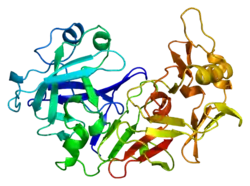
PGA5 (англ. Pepsinogen 5, group I (pepsinogen A)) – білок, який кодується однойменним геном, розташованим у людей на короткому плечі 11-ї хромосоми.[2] Довжина поліпептидного ланцюга білка становить 388 амінокислот, а молекулярна маса — 41 993[3].
Послідовність амінокислот
| 10 | 20 | 30 | 40 | 50 | ||||
|---|---|---|---|---|---|---|---|---|
| MKWLLLLGLV | ALSECIMYKV | PLIRKKSLRR | TLSERGLLKD | FLKKHNLNPA | ||||
| RKYFPQWEAP | TLVDEQPLEN | YLDMEYFGTI | GIGTPAQDFT | VVFDTGSSNL | ||||
| WVPSVYCSSL | ACTNHNRFNP | EDSSTYQSTS | ETVSITYGTG | SMTGILGYDT | ||||
| VQVGGISDTN | QIFGLSETEP | GSFLYYAPFD | GILGLAYPSI | SSSGATPVFD | ||||
| NIWNQGLVSQ | DLFSVYLSAD | DKSGSVVIFG | GIDSSYYTGS | LNWVPVTVEG | ||||
| YWQITVDSIT | MNGETIACAE | GCQAIVDTGT | SLLTGPTSPI | ANIQSDIGAS | ||||
| ENSDGDMVVS | CSAISSLPDI | VFTINGVQYP | VPPSAYILQS | EGSCISGFQG | ||||
| MNVPTESGEL | WILGDVFIRQ | YFTVFDRANN | QVGLAPVA |
| PGA5 | |||||||||||||||||
|---|---|---|---|---|---|---|---|---|---|---|---|---|---|---|---|---|---|
 |
|||||||||||||||||
| Ідентифікатори | |||||||||||||||||
| Символи | PGA5, Pg5, pepsinogen 5, group I (pepsinogen A), pepsinogen A5 | ||||||||||||||||
| Зовнішні ІД | OMIM: 169730 HomoloGene: 68135 GeneCards: PGA5 | ||||||||||||||||
| |||||||||||||||||
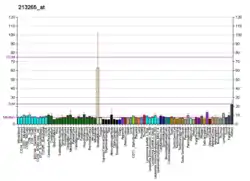
| Шаблон експресії | |||||||||||||||||
 | |||||||||||||||||
| Більше даних | |||||||||||||||||
| Ортологи | |||||||||||||||||
| Види | Людина | Миша | |||||||||||||||
| Entrez |
|
| |||||||||||||||
| Ensembl |
|
| |||||||||||||||
| UniProt |
|
| |||||||||||||||
| RefSeq (мРНК) |
|
| |||||||||||||||
| RefSeq (білок) |
|
| |||||||||||||||
| Локус (UCSC) | Хр. 11: 61.24 – 61.25 Mb | н/д | |||||||||||||||
| PubMed search | [1] | н/д | |||||||||||||||
| Вікідані | |||||||||||||||||
| |||||||||||||||||
Кодований геном білок за функціями належить до гідролаз, протеаз, аспартилових протеаз, фосфопротеїнів. Секретований назовні.
Див. також
Примітки
- Human PubMed Reference:.
- HUGO Gene Nomenclature Commitee, HGNC:8887 (англ.). Процитовано 8 вересня 2017.
- UniProt, P0DJD9 (англ.). Процитовано 8 вересня 2017.
Література
- The status, quality, and expansion of the NIH full-length cDNA project: the Mammalian Gene Collection (MGC).. Genome Res. 14: 2121 — 2127. 2004. PubMed DOI:10.1101/gr.2596504
- Ichihara Y., Sogawa K., Takahashi K. (1985). Isolation of human, swine, and rat prepepsinogens and calf preprochymosin, and determination of the primary structures of their NH2-terminal signal sequences.. J. Biochem. 98: 483 — 492. PubMed DOI:10.1093/oxfordjournals.jbchem.a135303
- Athauda S.B.P., Tanji M., Kageyama T., Takahashi K. (1989). A comparative study on the NH2-terminal amino acid sequences and some other properties of six isozymic forms of human pepsinogens and pepsins.. J. Biochem. 106: 920 — 927. PubMed DOI:10.1093/oxfordjournals.jbchem.a122952
- Foltmann B. (1988). Activation of human pepsinogens.. FEBS Lett. 241: 69 — 72. PubMed DOI:10.1016/0014-5793(88)81033-0
- Fujinaga M., Chernaia M.M., Tarasova N.I., Mosimann S.C., James M.N.G. (1995). Crystal structure of human pepsin and its complex with pepstatin.. Protein Sci. 4: 960 — 972. PubMed DOI:10.1002/pro.5560040516
- Huang W.-Y., Tang J. (1970). Carboxyl-terminal sequence of human gastricsin and pepsin.. J. Biol. Chem. 245: 2189 — 2193. PubMed
This article is issued from Wikipedia. The text is licensed under Creative Commons - Attribution - Sharealike. Additional terms may apply for the media files.